
A striking stone building at 2431 West Roosevelt Road in the Douglas Park neighborhood of Chicago announces itself with carved limestone bearing the phrase Gut Heil — “Good Health” — alongside a portrait relief of Friedrich Ludwig Jahn, who founded the Turner movement.
The Turnverein Vorwaerts, whose name translates roughly as “Forward Turners,” was established in 1867. Its campaign to bring gymnastics into Chicago’s classrooms dates to 1884, when the organization arranged for members of a Chicago Board of Education committee to attend a gymnastics exhibition conducted by William Zoeller. The Board subsequently engaged a Turner to construct a physical education curriculum for the city’s schools — essentially building the program from the ground up. Fourteen years later, in 1898, the Vorwaerts strengthened that commitment by supplying gymnastic equipment to six public schools that were in the process of establishing playgrounds.
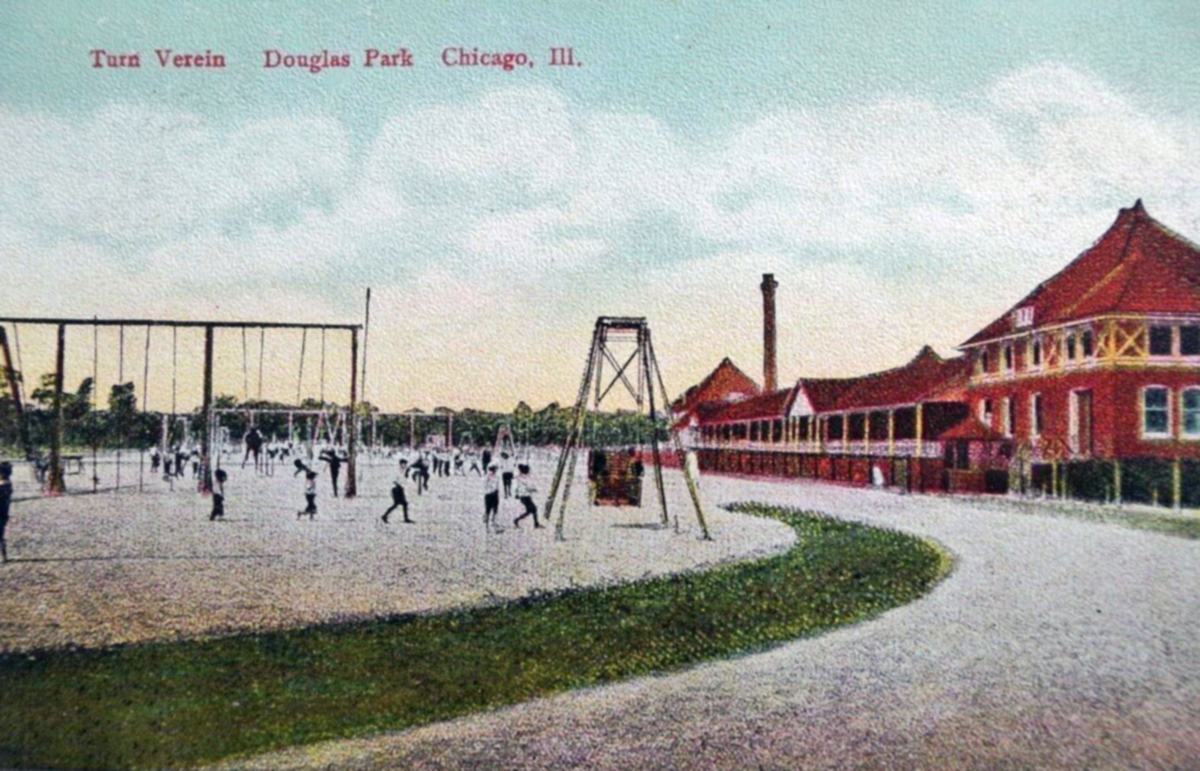
The organization’s reach extended far beyond schools. Throughout the late nineteenth century, Chicago’s public parks catered almost exclusively to quiet pursuits — leisurely walks, carriage excursions, and riding on horseback. The Turnverein Vorwaerts was instrumental in pushing that vision aside. In 1895, its members produced detailed architectural plans for a playground and natatorium at Douglas Park, and gathered 56,000 signatures on a petition urging the West Park Commission to act. The Commission agreed, and construction was finished by October 1896 — delivering what came to be recognized as Chicago’s first formal public playground. The Turners’ presence in the parks continued for decades: member George Sonnenleiter held the position of Chicago’s Municipal Playground Director from 1902 through 1932, and eight additional Vorwaerts members served as directors of individual parks across the city.
In time, the Turnverein Vorwaerts joined with other Chicago Turner associations to become the Northwest Turners. The Roosevelt Road building has long since passed to other owners and now carries designation as a Chicago Landmark. Yet the inscription Gut Heil still greets passersby above the windows.