
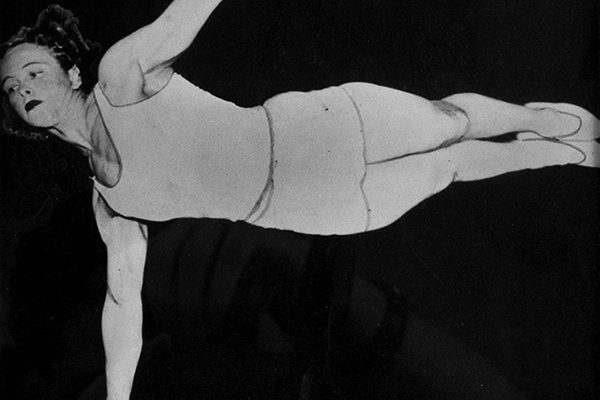
In the summer of 1936, the world’s eyes turned to Berlin as athletes from across the globe prepared to compete before a regime eager to turn sport into propaganda. For the Philadelphia Turners, that summer carried a special meaning. Four of its members won places on the United States Olympic team. One of them, Pearl Perkins, had won the right to go to Berlin—and then she walked away.
Pearl was born in South Philadelphia to Russian Jewish immigrants, Benjamin and Sadie Perkins. A natural athlete, by age twelve, she had already won five swimming championships and had become a standout in track and field.
At the Turngemeinde Athletic Club—the Philadelphia Turners—Pearl found both training and a home. The Turner movement had long taught that physical strength and civic character belonged together. Pearl embodied that ideal. At South Philadelphia High School for Girls, she helped lead one of the city’s finest gymnastics teams. She continued to participate in Turner Festivals, often in the septathalon and diving in addition to apparatus.
Then came 1936. The Olympic Games had been awarded to Berlin in 1931, before Adolf Hitler came to power. By the time the Games arrived, the Nazi regime had stripped Jews of rights and citizenship and pushed Jewish athletes out of German sports organizations. For many Americans, the question was whether they should lend their presence to a regime built on hatred. The debate divided American sports. Some leaders urged a boycott while others argued that the United States should attend. In the end, the American team went to Berlin.
In 1936, at age twenty-one, Pearl won the Middle Atlantic AAU all-around title and earned one of only eight places on the U.S. Women’s Olympic Gymnastics Team. But her parents said no. Benjamin and Sadie Perkins would not allow their Jewish daughter to compete in Nazi Germany. Pearl accepted their decision and gave up the chance of a lifetime.
Her story did not end there. Pearl remained, as Turner Topics stated in 1938, “America’s outstanding woman athlete.” She became National AAU all-around champion in 1937, 1941, and 1943, and won national titles in horse and vault. But she missed her opportunity at the Olympics, which were not held during the war years.
Most Americans remember the 1936 Games through Jesse Owens, whose victories offered a powerful rebuke to Nazi claims of racial superiority. Pearl Perkins represents another kind of courage: the athlete who refused to appear at all.
Pearl Perkins reminds us that Turner ideals were never only about medals. They were about character—about the strength to know when conscience matters more than glory.